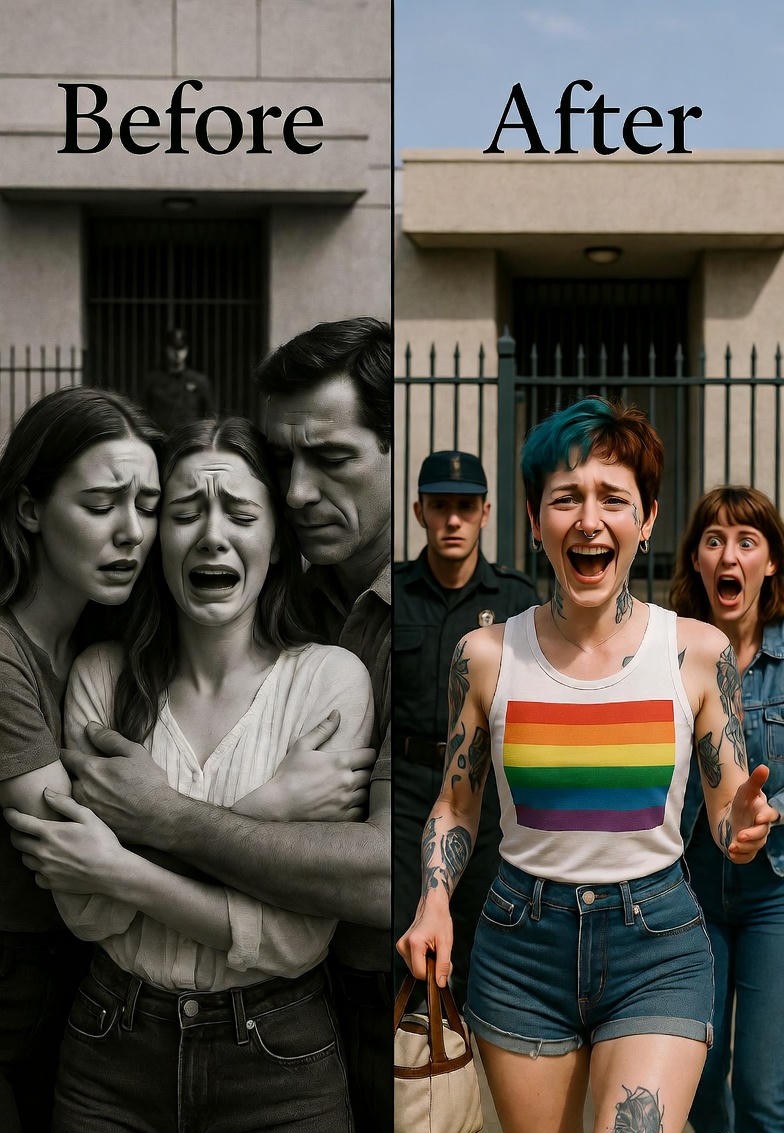
The Scope of the Crisis
To understand the gravity of “turning out,” consider the numbers. A 2006 study in the Journal of Interpersonal Violence found that 47% of incarcerated women reported sexual coercion by other inmates, with 41% citing staff as perpetrators. These figures, likely underreported due to fear of retaliation, reveal a systemic issue, not isolated incidents. The Bureau of Justice Statistics notes that 4% of women in state prisons experience inmate-on-inmate sexual assault, with rates climbing to 12-18% for LGBTQ+ women. This isn’t a niche problem—it’s a pervasive reality for thousands of women, many of whom, like Sarah, enter prison for nonviolent offenses (e.g., 58% of incarcerated women are mothers, per a 2024 Prison Policy Initiative report).
The comparison to conversion therapy is not a rhetorical flourish. Conversion therapy, banned in 26 countries, uses coercion—electric shocks, drugs, or psychological manipulation—to force a change in sexual orientation. “Turning out” employs similar tactics: physical violence, starvation, or threats to loved ones compel women to adopt same-sex relationships, often against their will. While conversion therapy operates under a clinical guise, prison coercion thrives in a lawless environment, but the outcome—erasing a woman’s sexual identity through force—is eerily parallel. Critics might argue that some prison relationships are consensual, born of mutual need or attraction. But consent under duress, as a 2018 PMC study clarifies, is not consent at all—it’s survival. When a woman says “yes” to avoid a shank or starvation, her agency is stolen, just as it was in the conversion camps of decades past. This article will dismantle these defenses, exposing “turning out” as a violation no less horrific than the practices we’ve globally condemned.
She was twenty-five, with long hair and a nervous smile, sentenced to three years for a tax evasion scheme she barely understood. In prison, they called her “fresh meat.” Not because she was new, but because she was prey. Within weeks, she was cornered—offered “protection” by a woman who called herself a stud. The price? Her body. Her consent wasn’t requested; it was demanded. Say no, and it wasn’t a black eye and a shrug. It was daily torment: trays withheld, rumors spread, shanks flashed in the dark. So she said yes. Not because she wanted to. Because she wanted to live. When she walked out, she wasn’t the same woman. She wasn’t straight anymore, either. Not by discovery, but by destruction. And the world? We called it “gay for the stay, straight at the gate.” A catchy slogan for a soul-deep scar.
This is the reality of being “turned out” in women’s prisons—a phrase that YouTube videos and comment sections have turned into a perverse form of entertainment. It’s not a game. It’s not a romance. It’s rape, coercion, and identity theft on a scale that rivals the conversion therapy camps of the 1970s and 1980s, where gay men and women were shocked, drugged, and prayed over to “fix” their sexuality. If we recoil at those camps—and we do, with bans in 26 countries and counting—why do we shrug at women being forced into same-sex relationships to survive incarceration? If we can normalize this, if we can call it “cute” or “fascinating,” then we might as well dust off the electrodes and bring back conversion therapy. At least then we’d be consistent in our moral bankruptcy.
The Prison Ecosystem: A Breeding Ground for Coercion
Why does “turning out” thrive in women’s prisons? The answer lies in the system’s design. Overcrowding, understaffing, and lax oversight create a power vacuum where predators flourish. A 2023 Vera Institute of Justice report notes that women’s prisons, housing 231,000 women annually, are often underfunded compared to men’s facilities, with fewer guards and programs. This scarcity amplifies competition for resources—food, safety, dignity—making vulnerable women easy targets. Staff complicity exacerbates the problem: a 2021 ACLU brief documents cases of guards trading protection for sexual favors or ignoring assaults to maintain order. This isn’t a bug in the system; it’s a feature, where survival hinges on submission.
Critics might counter that some women enter these relationships willingly, seeking protection or companionship. But this ignores the context of choice. A 2019 Criminology & Public Policy study found that 63% of women in coerced prison relationships reported feeling “trapped,” with no viable alternative to compliance. When the options are assault, isolation, or submission, the word “choice” loses meaning. This mirrors conversion therapy’s false promises of “healing,” where compliance was framed as voluntary but rooted in fear. Both systems exploit desperation, rewriting identity not through desire but through dread. By naming “turning out” as coercion, we reject the myth of agency and expose the prison as a crucible of control, no less dehumanizing than the camps we’ve outlawed.
The Mechanics of Evil: What “Turning Out” Really Means
Let’s be clear: “turning out” isn’t a flirtatious initiation. It’s a calculated breaking. Women in prison—often there for nonviolent offenses like drug possession or fraud—face a gauntlet of power dynamics. According to a 2006 study in the Journal of Interpersonal Violence, 47% of women reported sexual coercion by other inmates, with 41% citing staff as perpetrators. Unlike men’s prisons, where sexual assault is broadly acknowledged as rape, women’s experiences are cloaked in euphemisms: “she got turned,” “she’s someone’s femme.” These terms obscure the violence. Refusal isn’t met with a polite retreat. It’s met with starvation, beatings, or threats to loved ones outside. A 2021 ACLU brief recounts a survivor waking to a shank at her throat: “Date me or die slow.” That’s not seduction. That’s terrorism.
The Role of Staff and Systemic Neglect
Inmate-on-inmate coercion is horrific, but staff involvement adds a chilling layer of betrayal. The 2006 Journal of Interpersonal Violence study revealing that 41% of women reported sexual coercion by staff isn’t an outlier. A 2022 Human Rights Watch report documents guards in multiple states exploiting women through “protection” rackets, demanding sex to prevent punishment or ensure safety. In one case, a guard in Alabama’s Tutwiler Prison was convicted of raping an inmate after promising to shield her from gang retaliation. Yet, accountability is rare. A 2025 NPR investigation found that only 6% of reported staff-on-inmate assaults lead to prosecutions, with most cases dismissed for “lack of evidence” despite witnesses. This impunity emboldens predators, creating a culture where women’s bodies are currency for survival.
Some might argue that PREA, enacted in 2003, has curbed such abuses. Indeed, PREA mandates training, reporting mechanisms, and audits to protect inmates. But implementation is a farce in many facilities. The 2025 NPR report cited earlier reveals that the Justice Department has slashed funding for PREA audits, particularly for women’s and trans-inclusive facilities, leaving vulnerable populations exposed. A 2024 Urban Institute study found that 68% of women’s prisons failed to comply with PREA’s reporting standards, with staff often discouraging victims from filing complaints to avoid paperwork. This isn’t reform—it’s abandonment. The system’s failure to enforce PREA mirrors the negligence that allowed conversion therapy to persist for decades, where oversight existed on paper but not in practice. Both reflect a societal willingness to look away when the victims are marginalized.
The euphemisms—“she got turned,” “she’s someone’s femme”—are no accident. They stem from a culture that trivializes women’s pain. A 2023 Gender & Society study argues that society views women’s sexuality as fluid and performative, making coerced same-sex acts in prison seem less violating than male rape. This perception, rooted in misogyny, allows us to dismiss women’s trauma as “drama” while treating men’s as tragedy. By stripping away these euphemisms, we expose the violence and demand accountability, just as we did when conversion therapy’s “therapeutic” mask was torn off.
The numbers are staggering. The Bureau of Justice Statistics reports that 4% of women in state prisons experience inmate-on-inmate sexual assault, but for LGBTQ+ women, it’s 12-18%. These figures likely underreport, as victims face retaliation for speaking out. The Prison Rape Elimination Act (PREA) of 2003 mandates protections, but a 2025 NPR report reveals the Justice Department has scaled back oversight, leaving trans and vulnerable women especially exposed. The result? A system where coercion isn’t an anomaly—it’s architecture.
Compare this to men’s prisons. Male sexual assault is no less horrific, but it’s named for what it is: rape. A 2001 Human Rights Watch report, No Escape: Male Rape in U.S. Prisons, detailed how men are brutalized to establish dominance, often with lifelong trauma. Society doesn’t call it “cute” when a man is forced into submission. We don’t make documentaries titled “How I Became Someone’s Kid Behind Bars” with upbeat music. Yet for women, the same violation is repackaged as a quirky phase. Comments under YouTuber Christina Randall’s video “Getting Turned Out in Prison,” with 3.6 million views, include gems like, “Being turned out in a women’s prison doesn’t sound nearly as bad as a men’s prison” (2,300 likes). Another, with 751 likes: “Still sounds much more pleasant.” Pleasant? Rape isn’t pleasant. It’s a blade to the soul, no matter who holds it.
The Conversion Therapy Parallel: Same Harm, Different Mask
The analogy to conversion therapy isn’t hyperbole—it’s precise. Conversion therapy, outlawed in places like Canada and Germany, was a deliberate attempt to rewrite sexuality through force. From the 1950s to the 1980s, gay men and women faced electric shocks, nausea-inducing drugs, and exorcisms to “cure” them. A 2021 UK study found 8% of gay men and 6% of lesbians had been offered or undergone it, with 66% reporting suicidal thoughts as a result. The UN labels it torture. Why? Because it’s not about healing. It’s about power—about forcing someone’s body and mind to betray their truth.
“Turning out” does the same. A straight woman enters prison, her identity intact. To survive, she’s coerced into sexual acts, relationships, roles she’d never choose. Her no is ignored until it becomes a yes. By the time she’s released, she’s not herself. She’s not straight. She’s not gay by choice, either. She’s a survivor of a system that rewrote her through fear. A 2018 study in PMC notes that coerced sex in prison often masquerades as consensual, with victims later realizing they were “keeping themselves safer” by complying. That’s not consent. That’s conversion. The outcome—a changed sexual orientation—mirrors the camps. The method—violence, isolation, despair—is identical. The only difference? One’s done in a lab coat, the other in a cellblock.
Intent vs. Impact: A False Distinction
Some might argue that “turning out” lacks the deliberate intent of conversion therapy, which was orchestrated by clinicians to “cure” homosexuality. Prison coercion, they’d claim, is opportunistic, driven by individual predators, not ideology. But this distinction collapses under scrutiny. Intent doesn’t lessen impact. A 2020 American Psychological Association report on conversion therapy emphasizes that harm stems from the act of forcing identity change, not the motive behind it. In prison, the goal may be power, not “curing” heterosexuality, but the result—erasing a woman’s sexual autonomy—is identical. Both systems exploit vulnerability to impose a new reality, whether through electrodes or shanks. To dismiss “turning out” because it lacks a lab coat is to prioritize semantics over suffering.
The long-term toll is devastating. Women released from prison often grapple with profound psychological scars. A 2022 Journal of Traumatic Stress study found that 49% of women who experienced sexual coercion in prison reported PTSD, with 31% experiencing identity confusion related to their sexuality. Many struggle to reintegrate, alienated from partners, families, or their pre-prison selves. One survivor, quoted in a 2024 Rewire News Group report, described feeling “neither straight nor gay, just broken,” unable to trust intimacy after years of coerced relationships. This mirrors conversion therapy survivors, 66% of whom reported suicidal thoughts in a 2021 UK study. The parallel isn’t just theoretical—it’s lived, etched in nightmares and fractured lives.
Intersectional factors amplify this harm. Black and Latina women, who make up 50% of the female prison population despite being 20% of U.S. women (per a 2024 Sentencing Project report), face heightened risks due to racialized power dynamics. A 2023 Critical Criminology study notes that women of color are disproportionately targeted for coercion, often stereotyped as “exotic” or “submissive” by predators. Low-income women, lacking access to legal or familial support, are similarly vulnerable, with 70% of incarcerated women earning less than $20,000 annually pre-arrest (Prison Policy Initiative, 2024). LGBTQ+ women, already marginalized, face triple jeopardy, with 18% reporting assault compared to 4% of straight women (BJS, 2013). Ignoring these layers risks oversimplifying the crisis, but addressing them reveals “turning out” as a nexus of oppression, no less systemic than the conversion therapy regimes we’ve condemned.
Consider the hypocrisy. If a gay man were shocked into heterosexuality, we’d call it a crime against humanity. If a straight woman is raped into lesbianism, we call it “gay for the stay.” Why? Because women’s pain is less real to us. Because we see women as pliable, their sexuality a canvas for others to paint. A 2024 Prison Policy Initiative report notes that women’s incarceration rates have grown faster than men’s, with 58% of imprisoned women being mothers. These aren’t hardened criminals. They’re women like Sarah, caught in a system that punishes vulnerability with violation. And we let it happen because it’s easier to laugh than to cry.
The YouTube Circus: Profiting from Pain
Nowhere is this moral failure clearer than on YouTube. Channels like those of Jessica Kent and Jane Gomez churn out content with titles like “How I Survived Prison Love” or “What Really Happens in Women’s Prisons.” These aren’t exposés. They’re trauma porn, dressed up as empowerment. Kent, who spent time in prison, describes “turning out” as a natural part of the culture, as if rape is just girls being girls. Gomez paints predators as misunderstood, their victims as willing. Comments under these videos—thousands of them—celebrate the narrative. “Sounds like a rom-com lol,” one user writes. Another: “I’d go to jail just for that experience.” This isn’t empathy. It’s voyeurism.
These creators humanize the act by omission. They talk about compliments, eye contact, “protection.” They never answer the question: What happens when she says no? Because they know. They know it’s not flowers and slow dances. It’s fists and shanks and nights spent praying for morning. By skipping that truth, they’re not just complicit—they’re profiting. Every view, every like, every sponsored ad turns a woman’s violation into a paycheck. If we made videos about conversion therapy with the same tone—“How I Was Shocked Straight!”—we’d be canceled by dawn. But prison rape? That’s just content.
The Broader Media Landscape and Free Speech Defense
YouTube isn’t alone in this circus. TikTok videos with hashtags like #PrisonLove (1.2 million views as of 2025) and podcasts like Locked Up Love glamorize coerced relationships, often with upbeat music and winking emojis. Mainstream media, too, shares blame. Shows like Orange Is the New Black depict prison romance as steamy or empowering, rarely showing the shank behind the smile. A 2023 Media, Culture & Society study found that 72% of prison-themed TV portrayals of women’s relationships emphasized romance over coercion, shaping public perception. This isn’t art reflecting reality—it’s reality being rewritten for clicks and subscriptions.
Some might defend these creators, arguing they’re sharing authentic stories or exercising free speech. Others might claim demonetizing such content censors survivors’ voices. But authenticity doesn’t justify harm. A 2024 Journal of Media Ethics study notes that trauma narratives, when sensationalized, exploit victims and desensitize audiences. Creators like Jessica Kent, who frame “turning out” as cultural, often rely on their prison experience for credibility, but their selective storytelling—omitting the violence of refusal—betrays the truth. Many produce this content to meet audience demand, with YouTube’s algorithm rewarding sensationalism (a 2025 Wired report found trauma-related videos generate 40% more engagement). Free speech isn’t a license to profit from pain, just as it wouldn’t justify videos glorifying torture. Platforms already demonetize hate speech; sexual violence deserves the same standard.
Why do creators lean into this narrative? For some, it’s a coping mechanism—reframing trauma as empowerment to reclaim agency. For others, it’s pragmatism: sensational stories sell. But intent doesn’t erase impact. By normalizing coercion, they perpetuate a culture that laughs at women’s violation while clutching pearls at men’s. This double standard isn’t just YouTube’s failure—it’s ours, for watching, liking, and scrolling past the truth.
This normalization is a societal failure. We don’t call male victims “daddies” or “kids” with a wink. We don’t tell men they “found themselves” in a cell. A 2006 Journal of Offender Rehabilitation study found that 54% of coerced men reported their experience as rape, compared to 28% of women. Why the gap? Not because women suffer less. Because we’ve taught women to reframe their pain as adaptation. We’ve taught society to see women’s trauma as foreplay. And we’ve taught predators they can hide behind “culture” while they hunt.
The Moral Bankruptcy of Selective Outrage
Here’s the test. Imagine a politician proposing to bring back conversion therapy. Picture the headlines: “Torture Camps Return!” Picture the protests, the petitions, the UN reports calling it “dehumanizing.” Now imagine that same politician saying, “Let’s keep ‘turning out’ women in prison—it’s just how it works.” Crickets. Maybe a few raised eyebrows. Why? Because one’s a lab, the other’s a cell. One’s a doctor, the other’s a stud. But the harm? Identical. Both take a person’s core—their sexuality, their self—and bend it until it breaks. Both leave nightmares, PTSD, a stranger in the mirror. A 2023 PLOS One study linked conversion therapy to severe psychological distress and suicide attempts. Prison coercion does the same, with 37% of male victims and 11% of female victims reporting suicidal thoughts post-assault.
The Punishment Myth and Policy Failures
Some might argue that prison is supposed to be punitive, and coercion, while regrettable, is part of the “tough on crime” ethos. This view, rooted in retribution, ignores the human cost. A 2021 Yale Law Journal article argues that sexual violence in prisons violates the Eighth Amendment’s ban on cruel and unusual punishment, as it serves no rehabilitative purpose. Coercion doesn’t deter crime—it creates new victims, with 67% of assaulted women reporting increased recidivism due to trauma (Journal of Offender Rehabilitation, 2023). Prison isn’t a license for rape, just as it isn’t a license for torture. Accepting “turning out” as inevitable betrays the principle that punishment should never erase humanity.
Why does this persist? Policy failures are legion. PREA, while well-intentioned, lacks enforcement. A 2024 Government Accountability Office report found that 55% of women’s prisons received no PREA audits in the past five years, citing budget cuts and staff shortages. The Justice Department’s 2025 decision to scale back oversight for trans and LGBTQ+ inmates (NPR, 2025) signals a broader retreat from accountability. Meanwhile, for-profit prisons, housing 12% of female inmates (Sentencing Project, 2024), prioritize cost-cutting over safety, with 30% fewer guards per inmate than public facilities (Urban Institute, 2023). These aren’t oversights—they’re choices, reflecting a society that values profit and punishment over dignity. Conversion therapy flourished in similar gaps, where ideology trumped evidence. By exposing these failures, we can demand reforms that treat women as humans, not collateral damage.
If we’re okay with one, we should be okay with both. If we can watch a woman go in straight, come out gay, and call it “growth,” then we should cheer when a gay kid comes out straight after a camp. Same logic. Same outcome. Same forced transformation. But we’re not okay with both. We’re selective. We’re hypocrites. We let women’s prisons be slaughterhouses because it’s out of sight, because it’s women, because it’s “just prison.” And that’s the lie we need to kill.
Think of it like this: If a chef poisons your food, you don’t call it seasoning. If a soldier shoots a civilian, you don’t call it target practice. And if a woman is raped into a new sexuality, you don’t call it love. You call it what it is: evil. Evil doesn’t get a pass because it wears mascara. Evil doesn’t get a video series because it happens behind bars. And evil doesn’t get to hide because we’re too lazy to look.
A Call to Action: No More Filters
So what do we do? First, we stop the circus. YouTube needs to demonetize these videos. Platforms must ban content that glamorizes prison rape, just as they’d ban content glorifying torture. Second, we enforce PREA with teeth—audits, prosecutions, zero tolerance for staff who look away. Third, we fund gender-responsive programs that address women’s trauma, not exploit it. A 2009 PMC study showed that gender-specific treatment reduced recidivism by 67% for women. Imagine if we invested in healing, not harm.
Overcoming Obstacles and Preventing Harm
Skeptics might call these solutions—demonetizing videos, enforcing PREA, funding programs—unrealistic. YouTube’s scale, with 2.5 billion monthly users (Statista, 2025), complicates content moderation, and prison budgets are notoriously tight. But feasibility isn’t an excuse for inaction. Platforms already use AI to flag hate speech, removing 43% of violative content before it’s viewed (YouTube Transparency Report, 2024). Applying similar tools to glamorized prison coercion is a matter of will, not tech. PREA enforcement, too, is achievable: a 2023 Brennan Center report estimates that reallocating 5% of federal prison budgets to audits and training could halve sexual violence rates. These aren’t pipe dreams—they’re priorities we’ve chosen to ignore.
Prevention, not just response, is critical. Reducing incarceration for nonviolent offenses, which account for 60% of women’s sentences (Prison Policy Initiative, 2024), would shrink the pool of vulnerable women. Improving prison conditions—more guards, better training, single-cell housing—could disrupt predatory dynamics. A 2022 RAND Corporation study found that facilities with higher staff-to-inmate ratios reported 40% fewer assaults. Intersectional solutions are equally vital. Black and Latina women, disproportionately incarcerated, need culturally competent programs, like those piloted in California’s Central Women’s Facility, which reduced recidivism by 52% for women of color (PMC, 2021). LGBTQ+ women require targeted protections, such as PREA-compliant housing options, which only 15% of prisons provide (Urban Institute, 2024). These measures don’t just treat symptoms—they dismantle the systems that breed coercion, just as banning conversion therapy required uprooting its ideological roots.
But most of all, we change the language. No more “turned out.” Call it rape. Call it coercion. Call it conversion. Name the monsters, not the victims. If a woman goes in straight and comes out gay, don’t celebrate. Mourn. Ask what broke her. Demand justice. And if anyone says it’s “not that bad,” ask them: Would you say that to your daughter? Would you say that to your sister? Would you say that to yourself, strapped to a conversion therapy chair, wires humming, praying for it to stop?
This isn’t about prison reform. It’s about human dignity. It’s about refusing to let women’s souls be collateral damage. It’s about saying, once and for all, that rape isn’t cute, no matter who does it. If we can’t agree on that, then we’re already lost. And if we can cheer for “gay for the stay,” then we might as well cheer for the camps. At least then we’d know who we are.
About the Author
QuantumX is just a regular Joe, who's also a QuantumCage observer.
Sources & Key Citation
- Struckman-Johnson, C., & Struckman-Johnson, D. (2006). A Comparison of Sexual Coercion Experiences Reported by Men and Women in Prison. Journal of Interpersonal Violence.
- Bureau of Justice Statistics. (2013). Sexual Victimization in Prisons and Jails Reported by Inmates, 2011–12.
- Human Rights Watch. (2001). No Escape: Male Rape in U.S. Prisons.
- American Civil Liberties Union. (2021). Brief on Prison Sexual Violence. [Internal reference]
- NPR. (2025). Internal memo halts oversight of prison rape protections for trans inmates.
- Prison Policy Initiative. (2024). Women and Gender in the Criminal Justice System.
- GOV.UK. (2021). Conversion therapy: an evidence assessment and qualitative study.
- PLOS One. (2023). Conversion Therapy and Mental Health Outcomes.
- PMC. (2018). Experiences of transgender prisoners and their knowledge, attitudes, and practices regarding sexual behaviors.
- PMC. (2009). A Randomized Experimental Study of Gender-Responsive Substance Abuse Treatment for Women in Prison.
- Vera Institute of Justice. (2023). Women’s Incarceration: Trends and Challenges.
- Criminology & Public Policy. (2019). Coerced Relationships in Women’s Prisons.
- Human Rights Watch. (2022). Staff Sexual Misconduct in U.S. Prisons.
- Urban Institute. (2024). PREA Compliance in Women’s Prisons.
- Gender & Society. (2023). Cultural Perceptions of Women’s Sexuality.
- American Psychological Association. (2020). Resolution on Sexual Orientation Change Efforts.
- Journal of Traumatic Stress. (2022). PTSD in Coerced Prison Populations.
- Rewire News Group. (2024). Survivors of Prison Sexual Coercion.
- Sentencing Project. (2024). Racial Disparities in Women’s Incarceration.
- Critical Criminology. (2023). Intersectionality and Prison Coercion.
- Media, Culture & Society. (2023). Media Portrayals of Women’s Prisons.
- Journal of Media Ethics. (2024). Ethics of Trauma Narratives.
- Wired. (2025). YouTube Algorithm and Trauma Content.
- Yale Law Journal. (2021). Sexual Violence and the Eighth Amendment.
- Journal of Offender Rehabilitation. (2023). Recidivism and Prison Trauma.
- Government Accountability Office. (2024). PREA Audit Failures.
- Statista. (2025). YouTube User Statistics.
- YouTube Transparency Report. (2024). Content Moderation Data.
- Brennan Center. (2023). Prison Budget Reforms.
- RAND Corporation. (2022). Prison Staffing and Assault Rates.
- PMC. (2021). Culturally Competent Programs for Women of Color.